
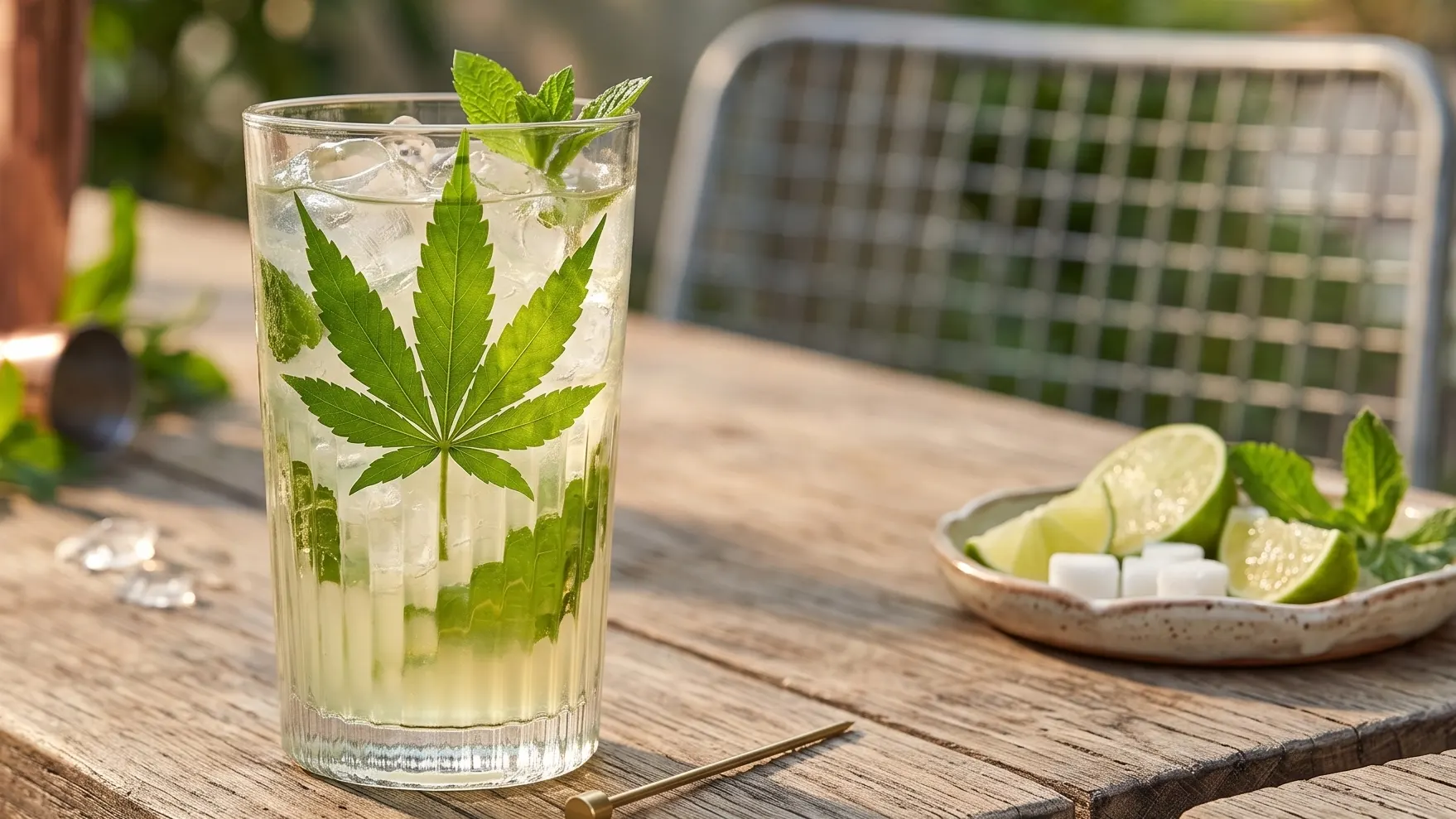
The “nano-emulsified” term shows up on more and more THC beverage labels today, and for good reasons. It’s even one of the reasons why a growing number of cannabis drinkers are switching away from smoking and traditional edibles entirely. The appeal simply comes down to two things: speed and predictability.
A standard THC gummy or oil-based edible can take anywhere from 30 minutes to over 2 hours to actually hit. Even then, the timing varies wildly from one session to the next; sometimes for the same person, using the same product, on two different days. Meanwhile, a nano-emulsified THC drink can start working in as little as 10 to 15 minutes. It’s closer to how a drink of alcohol feels than anything most edible users are used to. This isn’t just a marketing claim; it’s a measurable difference in how the body absorbs the two formulations, backed by actual pharmacokinetic testing rather than anecdote.
This guide and discussion walk you through the actual science behind that difference. The nanoemulsion technology, how it changes absorption pathways in the human body, and what the real pharmacokinetic study data shows. At the same time, get practical guidance on how to shop for and dose these THC drinks responsibly at Elevated Herb.
Nanoemulsion technology exists to solve a basic chemistry mismatch: THC is fat-soluble (hydrophobic), and water isn’t a fat-friendly environment. That’s historically why early cannabis-infused drinks had a reputation for tasting oily, separating in the can, or hitting inconsistently from one sip to the next. Back then, THC simply wasn’t staying evenly distributed in a water-based liquid.
Nanoemulsion technology solves that at the manufacturing level. Producers of nano-emulsified THC beverages use high-shear mixing or ultrasonic processing, combined with food-safe emulsifiers, to break THC oil down into microscopic droplets small enough to stay suspended evenly throughout a water-based beverage rather than separating. It’s the same general category of technology that’s already used in some flavored beverages and pharmaceutical formulations. So, to make it clear: cannabis manufacturers didn’t invent nanoemulsion; they adapted it.
This matters so much because of THC bioavailability. This is how much of a dose actually makes it into your bloodstream to have an effect. Published estimates for smoked or vaped THC vary widely. Multiple independent reviews put the real-world range anywhere from roughly 2-56%, depending on inhalation technique, puff depth, and hold time. Meanwhile, oral THC bioavailability sits in a much narrower, consistently lower band of about 4-12%. That low, inconsistent oral bioavailability is exactly the slow, unpredictable absorption problem that nano-emulsified THC drinks’ onset-time research is trying to solve. Getting more of the dose into the bloodstream, faster and more consistently, without requiring anyone to inhale anything.
To understand why nanoemulsion changes onset time so dramatically, it helps to understand what happens when THC is swallowed as a standard oil inside a typical capsule or gummy. When you take it as a standard oil, that oil has to be digested, absorbed through the gut wall, and processed by the liver before it reaches general blood circulation. During that liver pass, a portion of the THC gets converted into 11-hydroxy-THC, which is a potent metabolite. However, this whole process is slow and notoriously inconsistent from person to person, which is exactly why traditional edibles have a reputation for delayed, unpredictable highs.
But nano-emulsified droplets sidestep a meaningful part of that bottleneck. Because the droplets are so small, they can be absorbed more easily and more rapidly through the mucous membranes lining the mouth, stomach, and gut. This lets a portion of the dose reach the bloodstream faster and with far less person-to-person variability. At the same time, it produces an onset pattern that behaves much more like alcohol than like a traditional cannabis edible.
The data backing this up is more than theoretical:
Across these studies, a company-run human trial, a preclinical pharmaceutical study, and a peer-reviewed academic crossover trial, the pattern holds consistently: nanoemulsion formulations reach peak concentration faster and more predictably than standard oil-based delivery. That consistency across three separate research teams, using three different testing methods, is part of why nanoemulsion has moved from a novelty ingredient to something closer to an industry standard for fast-acting beverages in just a few years.
| Consumption Method | Typical Onset Time | How Long It Lasts | How Predictable |
|---|---|---|---|
| Smoking / Vaping Flower | 1–10 minutes | 1–3 hours | Fast and reliable, but tough on the lungs and hard to dose exactly |
| Traditional Oil-Based Edible | 30–120 minutes | 4–8 hours | Inconsistent, and held up by digestion and liver processing |
| Nano-Emulsified THC Beverage | 10–30 minutes | 1.5–3 hours | Reliable and steady, closer to how alcohol feels |
| Nano-Emulsified Oral/Sublingual Spray | 15–45 minutes | 2–4 hours | Fairly reliable, though a bit more variable than a drink |
A few things beginners ask us most:
Nano-emulsified THC drinks are one of the fastest-acting, most predictable ways to enjoy cannabis today. No smoke, no guessing, no two-hour wait. Elevated Herb carries a curated selection of lab-tested, fast-acting THC beverages for West Milford shoppers who want a cleaner, more controllable experience.